
Most people don’t say, “I’m struggling.”
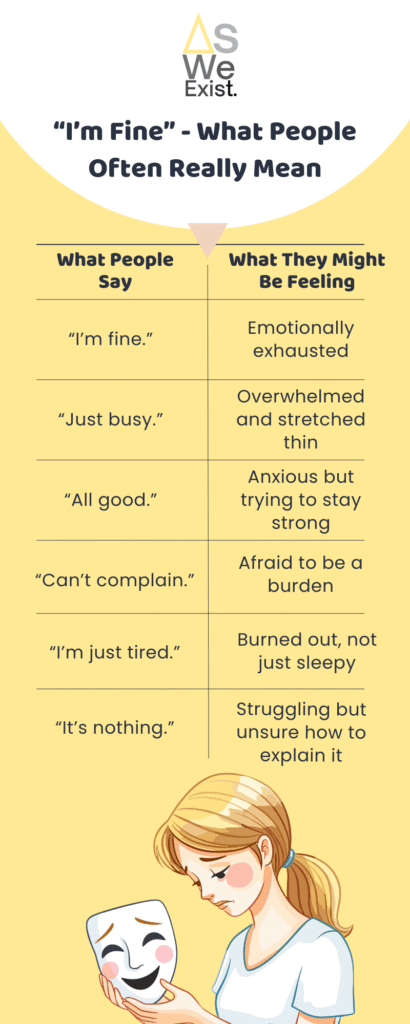
They say, “I’m fine.” They say it quickly. Automatically. Like a reflex. Sometimes they say it because they don’t want to explain. Sometimes, because they don’t want to worry anyone.
And sometimes, because they’ve said it so many times, they’re not sure what the real answer is anymore. This is where mental health matters the most, not during dramatic moments, but in these quiet, everyday exchanges where something real gets hidden behind a familiar phrase.
I once heard someone say they realized something was wrong not during a breakdown, but while brushing their teeth. They were standing there, staring at their own reflection, and suddenly thought, “I don’t remember the last time I felt light.” Nothing dramatic had happened. Life was moving. But something inside felt tired in a way sleep couldn’t fix.
Why do we hide what we’re really feeling
The truth is, a lot of us are carrying things quietly. We show up. We work. We smile. We reply to messages. We get things done. And inside, something feels heavy.
Mental health is still whispered about because we’re taught, very early, that struggling means something is wrong with us. That we should be able to “handle it.” That other people have it worse, so we should be grateful and move on.
So, we learn to hide. We hide stress behind productivity. We hide anxiety behind jokes. We hide exhaustion behind responsibility. And forget that our mental health matters too.
“Just because I’m functioning doesn’t mean I’m okay.”
Many people don’t talk about their mental health, not because they don’t want help, but because they don’t know how to start the conversation. Or they’re afraid of being judged. Or they think their feelings aren’t “serious enough” to matter.
But here’s a quiet truth that doesn’t get said enough:
We all struggle. Just quietly. In different ways. At different times. For different reasons. Some struggles are loud. Many are invisible. And when we keep hiding them, they don’t disappear. They pile up. They manifest as burnout, irritation, numbness, or a feeling of disconnection from our own lives. Mental health matters because emotional strain doesn’t stay in the mind; it quietly affects sleep, focus, relationships, and everyday decision-making.
Hiding it only makes things worse.
What mental health really means in real life (and why mental health matters)
More than 1 billion people globally live with a mental health condition, showing just how widespread this experience is beyond extreme cases. When people hear the words mental wellness, they often think of extreme situations. Something serious. Something rare.
But mental health is much simpler than that.
Mental health is about how you feel, think, cope, and respond to everyday life. It’s how you handle stress, how you talk to yourself, how you react when things don’t go as planned. It’s not just about illness, it’s about daily emotional well-being.
You can have good mental health and still have bad days.
You can struggle sometimes and still be “okay.” Both things can exist at the same time.
According to the World Health Organization, 1 in 8 people worldwide live with a mental health condition. That’s not a small group, that’s people we work with, live with, and love.
And here’s something else many don’t realize: mental health isn’t fixed. It changes with sleep, stress, relationships, work, and life events. Just like physical health, it moves up and down. Mental health includes everyday emotional well-being, not just diagnosed conditions, and it changes over time based on stress, relationships, and life events.
Mental health matters every day, not only when things feel unbearable, but also when they quietly start to feel heavy.
So, what does “mental health matters” actually mean?
It means recognizing that emotional well-being is just as important as physical health. Mental health affects how we think, feel, cope, and connect with others, and ignoring it can quietly impact every part of daily life.
Common mental health struggles people usually hide
Some struggles don’t look like struggles at all. They look like getting through the day, being responsible and showing up even when you’re tired.
From the outside, everything seems fine. But on the inside, there’s a quiet exhaustion that doesn’t go away with sleep.
Smiling on the outside
One of the most common hidden struggles is smiling on the outside while feeling exhausted inside. You laugh at the right moments. You reply to messages. You meet expectations. But everything feels heavier than it used to. Even small decisions take effort. Even simple tasks feel draining.
High-functioning anxiety
This one hides particularly well. You’re organized. You get things done. People depend on you. But your mind is always racing. You replay conversations long after they’re over. You worry about things before they happen. Rest feels uncomfortable because your thoughts won’t slow down.
In the United States, nearly one in every five adolescents ages 12-17 had a diagnosed mental or behavioral health condition in 2023, including anxiety and depression, showing that emotional struggles among young people are far from rare.
Quiet depression
Quiet depression is another struggle that often goes unnoticed. It doesn’t always show up as sadness. Sometimes it looks like numbness. Or a lack of interest in things that once brought joy. You don’t feel terrible, but you don’t feel alive either. Days blend together. Time passes, but you feel disconnected from it.
Burnout that looks like “being responsible.”
Burnout is often mistaken for being hardworking or responsible. It hides behind long hours, constant availability, and pushing through exhaustion. Over time, it leaves you feeling emotionally empty, irritable, and detached. You’re not lazy, you’re depleted.
Emotional numbness
And then there’s emotional numbness. When feelings have been ignored for too long, the mind sometimes shuts them down as a form of protection. You don’t feel deeply sad or happy; you just feel distant. Like you’re watching your life instead of living it.
“Not all pain is loud. Some of it just makes you tired.”
Mental health struggles are common, often invisible, and not a sign of weakness, even when someone appears to be functioning well.
These struggles are hidden because they’re easy to explain away. We tell ourselves we’re overthinking. That others have it worse. That this is just how life is. But this is exactly why mental health matters. Because pain doesn’t need to be visible to be real. And struggling quietly still counts as struggling.
The emotions we don’t know how to explain
Not every emotion comes with a clear label.
Sometimes you’re not sad. You’re not angry. You’re just… unsettled.
Bottled emotions
A lot of people carry bottled emotions without realizing it. Feelings that didn’t feel safe, convenient, or important enough to express at the time. So they were pushed down. Over time, those unspoken emotions don’t disappear; they wait.
Anger as a cover emotion
Anger often becomes the cover emotion. It’s easier to say “I’m irritated” than to admit “I’m hurt,” “I’m overwhelmed,” or “I feel invisible.” Anger feels active. Vulnerability feels risky.
Feeling empty for no reason
Then there’s that quiet feeling of emptiness. Nothing is technically wrong, yet nothing feels right either. You go through your routine, but joy feels muted. Motivation feels forced. You wonder why you feel this way when life looks okay on paper.
Guilt for feeling “ungrateful”
And with all of this comes guilt. Guilt for feeling ungrateful. Guilt for struggling when you “should” be happy. Guilt for wanting rest when others expect strength.
“Your feelings don’t need permission to exist.”
When emotions go unrecognized or unexpressed, they don’t disappear; they influence how people think, react, and relate to others over time. This is another reason mental health matters.
How modern life quietly damages mental health
Most mental health struggles today don’t come from one big event. They come from the slow buildup of small pressures we barely notice. Life keeps moving faster, louder, and more demanding, while we’re expected to keep up without complaint.
Nothing feels obviously “wrong.” And yet, many people feel constantly tired, mentally cluttered, or emotionally stretched thin. This isn’t a personal failure, it’s a reflection of how modern life is designed.
Always switched on
Our days begin and end with screens. Messages, alerts, news, and reminders follow us everywhere. The mind rarely gets a real break, even when the body stops moving.
Quiet comparison
Social media has made comparison part of daily life. We see other people’s progress, happiness, and success without seeing the full picture. Over time, this can quietly affect how we feel about ourselves.
The pressure to keep going
Hustle culture celebrates pushing through exhaustion. Rest starts to feel undeserved. Many people ignore stress signals until burnout becomes the only thing that forces them to stop.
No space to process
Silence has almost disappeared. Without pauses, emotions don’t get processed, they get buried. Stress becomes normal. Overwhelm becomes routine.
This is one of the reasons people are finally beginning to say that mental health matters, not as a slogan, but as a reminder that our minds need care just as much as our bodies do.
What actually helps mental health: small, real steps that work
When mental health feels heavy, it’s easy to believe that the solution has to be big. A complete lifestyle change. A perfect routine. A sudden breakthrough.
But most healing doesn’t work like that. Taking care of mental health often starts with small, consistent actions rather than sudden or dramatic changes.
Start with what’s manageable
When everything feels like too much, begin with the basics. Sleeping a little more regularly. Eating something nourishing. Stepping outside for a few minutes of fresh air. These might sound simple, but they create a sense of safety for the mind. Stability often comes before clarity.
You don’t have to feel “better” to start taking care of yourself. Care can come first.
Rest without earning it
Many people believe rest must be justified. That you need to be productive, helpful, or exhausted enough to deserve it. But rest is not a reward, it’s maintenance.
Allowing yourself to pause, even briefly, helps the nervous system calm down. It reminds your mind that it doesn’t have to stay alert all the time just to survive.
Talk safely, not perfectly
You don’t need to explain everything clearly. You don’t need the right words. You just need someone who can listen without minimizing your feelings or rushing to fix them.
Sometimes saying, “I don’t know what’s wrong, I just feel off,” is enough to begin.
Therapy is support, not a label
Therapy isn’t only for moments of crisis. It can help you understand patterns, process emotions, and learn healthier ways to cope with stress before things feel overwhelming. Seeking support doesn’t mean something is broken. It means you’re choosing to care for your mind intentionally.
Knowing when to ask for help
If heaviness lasts for weeks, if numbness feels constant, or if daily life starts to feel unmanageable, reaching out is important. You don’t need to wait until things fall apart.
This is where the idea that mental health matters becomes real, not through dramatic changes, but through steady, compassionate choices that support you over time.
Let’s normalize talking about it
Silence is one of the biggest reasons people stay stuck.
When no one talks about their struggles, it’s easy to believe you’re the only one feeling this way. That everyone else has life figured out. That your emotions are a personal failure instead of a human experience.
But silence doesn’t protect us; it isolates us.
Talking about mental health doesn’t require perfect words or dramatic honesty. Sometimes it’s just saying, “I’ve been feeling off lately,” or “I’m not okay, but I don’t know why.” Those small moments of truth can be surprisingly relieving.
What helps most isn’t advice. It’s being heard. It’s someone listening without minimizing, fixing, or rushing you. Feeling understood often brings more comfort than solutions ever could.
Mental health struggles are not a sign of weakness. They’re a sign that you’re human in a world that can be demanding and overwhelming. When we speak about them openly, we make space for others to do the same.
Your mental health matters, not only in moments of crisis, but in everyday life.
Not sometimes. Not only when things fall apart. Every day.
FAQs
What does “mental health matters” mean?
It means recognizing that emotional well-being is just as important as physical health. Mental health affects how people think, feel, cope with stress, and connect with others in daily life.
Why is mental health important in everyday life?
Mental health influences energy levels, focus, relationships, and decision-making. When it’s ignored, even routine tasks and responsibilities can start to feel overwhelming.
What are common mental health struggles people hide?
Many people quietly experience anxiety, burnout, emotional numbness, or low mood without outward signs. These struggles are often dismissed because they don’t always look severe.
How can someone start taking care of their mental health?
Small steps like resting without guilt, talking to someone safe, and paying attention to emotional needs can help. Care doesn’t require perfection; it requires consistency.
When should someone seek help for mental health?
If emotional heaviness lasts for weeks, interferes with daily life, or feels unmanageable, reaching out for support is important. Seeking help is a form of self-care, not failure.